Where Is Darma Valley?
Darma Valley is a Himalayan valley in Pithoragarh district, in the far east of Uttarakhand's Kumaon region. It sits close to the borders with Nepal and Tibet, with the Kuthi Yankti valley on one side and the Lassar Yankti valley on the other. Most travellers reach it through Dharchula, the last big town on the way.
That distance is part of the charm. Darma Valley has no crowded viewpoints and no row of cafés. What it has is a long, winding road, a river that never goes quiet, and snow peaks that appear one bend at a time.
The River That Shapes the Valley
The valley is named after the Darma river, also called Darma Ganga. It begins near the Sino-Indian border, flows south and, further down, becomes the Dhauliganga. At Tawaghat the Dhauliganga meets the Kali river, and you pass that meeting point on the way into the valley.
For most of the drive the river is beside you, sometimes far below the road and sometimes right at the edge. The sound of it is one of the first things travellers remember about the valley.
Panchachuli: Five Peaks, One Skyline
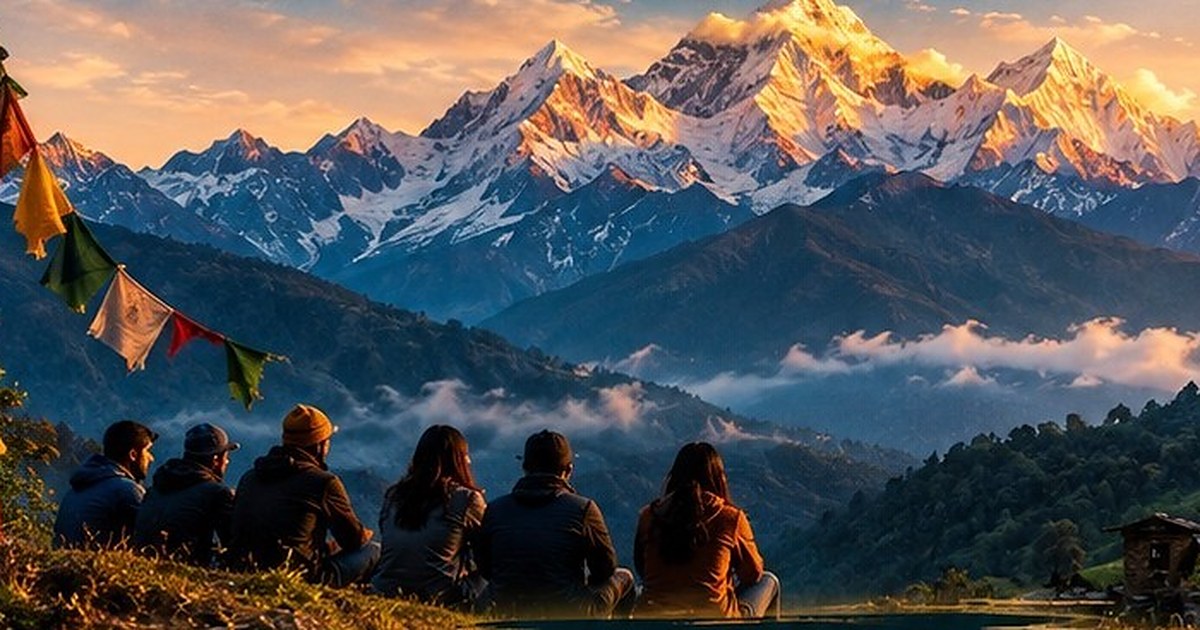
The star of the valley is the Panchachuli massif, a group of five snow-covered peaks that range from about 6,334 m to 6,904 m. The highest, Panchchuli II, is the highest peak that lies entirely in the Kumaon region. The massif rises near Dugtu village in Darma Valley.
Local belief links the name to the Pandavas of the Mahabharata, whose five cooking hearths, the "five chulis", are said to have inspired it. Whether you take the story literally or not, the five peaks standing in a row do look like a place where something important happened.
The best moments come at sunrise and just after sunset, when the snow turns gold and then pink. If the sky is clear, it is the picture most people take home from the valley.
Villages, People and Mountain Life
Darma Valley has about 12 villages and a small population. The people are largely Bhotiya, with a long history as livestock rearers and traders on the old routes towards Tibet. In the fields you will see crops like buckwheat and potatoes, grown in a short mountain season.
Villages such as Dugtu and Dantu sit among terraced slopes and stone-and-wood houses, with snow peaks behind them. Life here moves slowly, and a guesthouse or homestay is usually the only way to stay. That simplicity is exactly why many travellers rate the valley as one of the most memorable places in Uttarakhand.
What the Journey Looks Like
Getting to Darma Valley is a journey in itself, and the road is part of the experience. On our trip the route runs like this:
- Delhi to Champawat. An overnight drive, then a stop at the Chitai Golu Temple, known for the many bells offered by devotees.
- Lohaghat and Koli Dhek Lake. A lake stop on the way, subject to access, before the long drive to Dharchula.
- Dharchula. A night in the gateway town, with the Kali river marking the border with Nepal.
- Nepal border area, Tawaghat and Sobla. A visit to the accessible border area near Dharchula, then the drive into Darma Valley.
- Dugtu and Dantu. A night in the valley with a campfire and music, subject to weather and local conditions.
- Panchachuli Base Camp walk. A walk towards the base camp route or viewpoints, with Zero Point if conditions allow, then the drive on to Pithoragarh.
When Is a Good Time to Go?
We run the trip in the post-monsoon months, when skies are usually clearer and the peaks show well. That is also a season when road access, weather and local permissions can change, so we plan with some flexibility and the Trip Captain adjusts the day if needed. If you prefer a lot of certainty and comfort, this is not that kind of trip, and we say so openly.
Is It Easy? An Honest Answer
It is a remote trip with long drives. The stays are simple hotels and homestays, and the last day of walking is the most demanding. The walk and the Zero Point extension depend on weather, daylight, fitness and local permissions, so they are never guaranteed. If you are looking for luxury, read why our trips are not luxury first. If you are comfortable with that, the valley rewards you well.
What to Pack
Warm layers, sturdy walking shoes, a raincoat, a torch, personal medicines and a valid government photo ID are the essentials. Our Himalayan trek packing list covers the rest.
Join the Darma Valley Trip With TTI
Our Darma Valley trip is a 4-day, 3-night group trip from Delhi to Delhi. It includes shared group transport, three nights of stay, three breakfasts and three dinners, the listed sightseeing, a campfire evening in the valley and a Trip Captain for coordination and first-aid support. Prices are ₹14,999 per person for quad sharing and ₹16,999 per person for double sharing, and you reserve your seat with an advance of ₹2,000 per person. Read how to book a trip with TTI for the full steps, or see what your money covers.
If you like quiet, far-away places, you may also enjoy our Munsiyari and Khaliya Top trip and the Harsil Valley trip.